Table of Contents
Key Takeaways
- Stainless steel 304 pipe fittings are among the most widely used piping components worldwide.
- They offer excellent corrosion resistance, strength, and fabrication performance.
- Common fitting types include elbows, tees, reducers, couplings, and unions.
- Stainless steel 304 pipe fittings are suitable for food processing, water treatment, chemical handling, and general industrial applications.
- International standards such as ASTM, ASME, and ISO ensure quality and compatibility.
- Proper material selection can significantly reduce maintenance costs and extend system lifespan.
- Understanding pressure ratings, dimensions, and connection methods is essential for successful piping design.
- Stainless steel 304 pipe fittings provide an excellent balance between cost and performance.
Introduction

In modern industrial piping systems, selecting the correct fitting material is just as important as choosing the pipe itself. Among all available materials, stainless steel 304 pipe fittings have become the industry standard for countless applications due to their outstanding corrosion resistance, mechanical strength, hygienic properties, and long service life.
Whether used in food processing plants, pharmaceutical facilities, water treatment systems, petrochemical installations, or commercial buildings, these fittings play a critical role in maintaining safe and efficient fluid transportation.
According to global stainless steel market reports, grade 304 accounts for approximately 50% of total stainless steel consumption worldwide, making it the most commonly used austenitic stainless steel. Its combination of affordability and performance has made it a preferred choice for engineers, contractors, and procurement professionals.
This guide explains the fundamentals of stainless steel 304 pipe fittings, including materials, specifications, applications, standards, advantages, limitations, and purchasing considerations.
Understanding Stainless Steel 304 Pipe Fittings
What Are Stainless Steel 304 Pipe Fittings?
Stainless steel 304 pipe fittings are components used to connect, redirect, terminate, branch, or control the flow within piping systems.
They create complete piping networks capable of transporting:
- Water
- Chemicals
- Food products
- Steam
- Gas
- Air
- Industrial fluids
Without fittings, even the highest-quality pipe cannot form a functional piping system.
Basic Material Composition
Grade 304 stainless steel belongs to the austenitic stainless steel family.
Typical chemical composition:
| Element | Percentage |
|---|---|
| Chromium (Cr) | 18–20% |
| Nickel (Ni) | 8–10.5% |
| Carbon (C) | ≤0.08% |
| Manganese (Mn) | ≤2.0% |
| Silicon (Si) | ≤1.0% |
The chromium content creates a passive oxide layer that protects against corrosion.
The nickel content improves ductility, toughness, and weldability.
Why Stainless Steel 304 Pipe Fittings Are So Popular
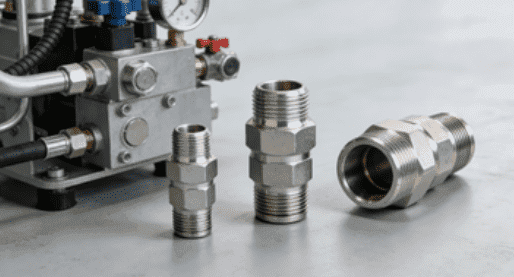
Corrosion Resistance Concept
One of the primary reasons for the widespread adoption of stainless steel 304 pipe fittings is corrosion resistance.
The chromium-rich surface continuously forms a protective oxide film that prevents rust formation in most atmospheric and industrial environments.
This protection allows the fittings to maintain structural integrity for decades.
Strength Concept
304 stainless steel provides an excellent combination of strength and toughness.
Unlike many alternative materials, it maintains mechanical performance under:
- High pressure
- Temperature fluctuations
- Mechanical vibration
This makes it suitable for demanding industrial conditions.
Hygiene Concept
The smooth surface of stainless steel minimizes bacterial growth and contamination.
For this reason, stainless steel 304 pipe fittings are extensively used in:
- Food processing facilities
- Dairy plants
- Beverage production
- Pharmaceutical manufacturing
Common Types of Stainless Steel 304 Pipe Fittings
304 Stainless Steel Elbows
Elbows change flow direction within a piping system.
Common Configurations
- 45° elbow
- 90° elbow
- Long-radius elbow
- Short-radius elbow
Elbows help optimize pipe routing while minimizing flow disruption.
304 Stainless Steel Tees
Tees create branch connections within pipelines.
Tee Categories
- Equal tee
- Reducing tee
- Barred tee
These fittings distribute flow into multiple directions.
304 Stainless Steel Reducers
Reducers connect pipes of different diameters.
Reducer Types
- Concentric reducer
- Eccentric reducer
Reducers help maintain efficient flow transitions while reducing turbulence.
304 Stainless Steel Couplings
Couplings connect two pipe sections together.
They are commonly used for:
- Repairs
- Extensions
- System modifications
304 Stainless Steel Unions
Unions allow easy disassembly without cutting the pipe.
This feature greatly simplifies maintenance procedures.
Stainless Steel 304 Pipe Fittings Standards and Specifications
Major International Standards
| Standard | Organization | Application |
| ASTM A403 | ASTM | Stainless steel fittings |
| ASME B16.9 | ASME | Butt-weld fittings |
| ASME B16.11 | ASME | Forged fittings |
| MSS SP-43 | MSS | Corrosion-resistant fittings |
| ISO 1127 | ISO | Stainless steel dimensions |
These standards ensure interchangeability and consistent quality.
Pressure Rating Concept
Pressure ratings vary according to:
- Material thickness
- Manufacturing process
- Temperature conditions
Typical classes include:
- Class 150
- Class 300
- Class 600
- Class 900
- Class 1500
Higher pressure classes are used in more demanding environments.
Stainless Steel 304 Pipe Fittings vs Other Materials
Material Comparison Table
| Feature | 304 Stainless Steel | Carbon Steel | PVC | 316 Stainless Steel |
| Corrosion Resistance | Excellent | Moderate | Good | Superior |
| Cost | Medium | Low | Low | High |
| Strength | High | High | Low | High |
| Food Grade | Yes | No | Limited | Yes |
| Marine Resistance | Moderate | Poor | Moderate | Excellent |
Selection Insight
Choose 304 stainless steel when balancing:
- Cost efficiency
- Corrosion protection
- Long-term durability
Choose 316 when chloride exposure is significant.
Applications of Stainless Steel 304 Pipe Fittings

Water Treatment Systems
Municipal and industrial water facilities frequently use stainless steel 304 pipe fittings because they resist corrosion while maintaining water quality.
Food and Beverage Industry
Sanitary piping systems depend on stainless steel due to its hygienic properties and ease of cleaning.
Chemical Processing Plants
Many chemical handling operations use grade 304 fittings for moderate corrosion environments.
Commercial Buildings
HVAC, fire protection, and plumbing systems often utilize stainless steel fittings for reliability and long service life.
Pharmaceutical Manufacturing
Cleanroom environments require contamination-resistant piping components.
304 stainless steel meets many pharmaceutical requirements.
Factors to Consider Before Purchasing Stainless Steel 304 Pipe Fittings
Operating Temperature
Temperature directly influences pressure capability and material performance.
Media Compatibility
Verify compatibility with:
- Acids
- Alkalis
- Chlorides
- Solvents
Connection Method
Common connection types include:
- Butt weld
- Socket weld
- Threaded
- Flanged
Compliance Requirements
Always verify compliance with relevant standards and project specifications.
Conclusion
Stainless steel 304 pipe fittings remain one of the most versatile and widely used solutions in modern piping engineering. Their excellent balance of corrosion resistance, mechanical strength, fabrication flexibility, and cost-effectiveness makes them suitable for a broad range of industrial applications.
By understanding material properties, fitting types, international standards, and application requirements, engineers and buyers can make informed decisions that improve reliability, safety, and long-term system performance.
FAQ
What are stainless steel 304 pipe fittings used for?
They are used to connect, branch, reduce, terminate, and redirect flow in industrial piping systems.
Are stainless steel 304 pipe fittings rust-proof?
They offer excellent corrosion resistance but may experience corrosion in highly aggressive chloride environments.
What is the difference between 304 and 316 pipe fittings?
316 contains molybdenum, providing superior resistance to chlorides and marine environments.
Are stainless steel 304 pipe fittings suitable for food applications?
Yes. They are widely used in food, beverage, and pharmaceutical industries.
How long do stainless steel 304 pipe fittings last?
With proper installation and maintenance, service life can exceed 20–50 years depending on operating conditions.