Key Takeaways
- Hydraulic flange fittings are critical sealing components in high-pressure hydraulic systems
- Supplier selection directly affects system safety, leakage rate, and lifecycle cost
- Material grade, pressure class, and international standards (SAE/DIN/ISO) are key decision factors
- Proper testing and certification significantly reduce hydraulic system failure risks
- Industry applications range from construction machinery to offshore oil platforms
- Engineering-grade procurement requires both technical evaluation and commercial comparison
- Advanced manufacturing technologies improve precision, durability, and consistency
Table of Contents
Introduction
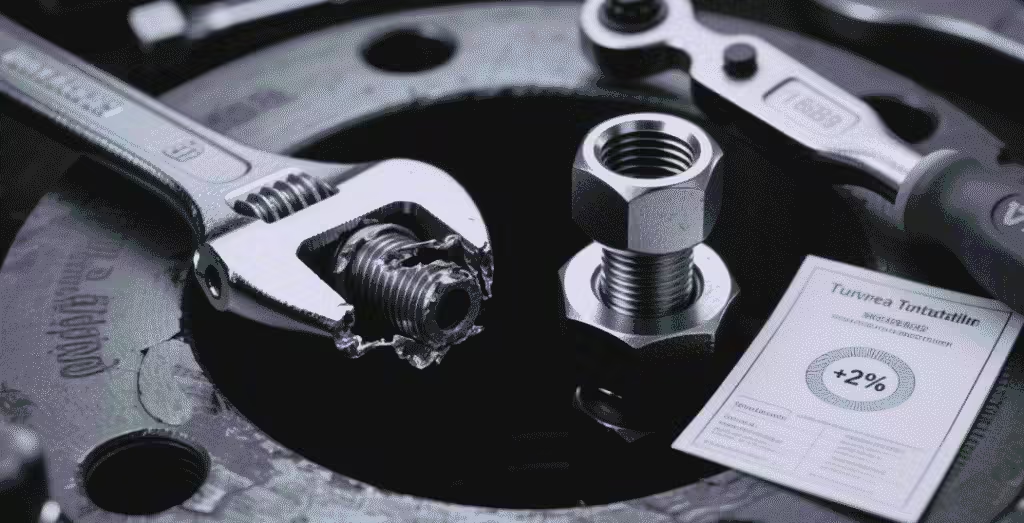
In modern industrial engineering, hydraulic systems operate under extreme conditions—high pressure, continuous vibration, temperature fluctuation, and chemically aggressive environments. In such systems, connection reliability becomes the defining factor of overall performance.
Among all connection components, hydraulic flange fittings are widely recognized as one of the most reliable solutions for high-pressure sealing and structural stability. Unlike threaded fittings, flange systems distribute stress more evenly across the joint surface, significantly reducing the risk of leakage or mechanical failure.
Global industrial reports (including hydraulic system white papers published by engineering associations in Europe and North America) consistently highlight that over 60% of hydraulic system downtime is related to leakage or connection failure rather than pump or actuator damage. This makes supplier selection for hydraulic flange fittings not just a procurement decision—but a system reliability strategy.
This guide provides a deep technical and commercial breakdown of how to evaluate suppliers, compare product categories, interpret industry standards, and optimize long-term procurement value.
Engineering Fundamentals of Hydraulic Flange Fittings
Structural Working Principle
Hydraulic flange fittings function through a bolted compression system that creates a uniform sealing force between mating surfaces.
This design provides:
- Even pressure distribution
- Reduced localized stress
- Strong vibration resistance
- Improved sealing reliability under dynamic loads
Why Flange Systems Outperform Threaded Connections
Threaded fittings are more vulnerable to:
- Micro-leakage under vibration
- Thread fatigue under pressure cycling
- Installation torque inconsistency
Flange systems eliminate many of these weaknesses by using:
- Flat sealing faces
- O-ring or metal sealing rings
- Bolt-driven compression force
Global Standards Governing Hydraulic Flange Fittings
SAE J518 Standard (Common in North America)
This is one of the most widely used standards for hydraulic flange fittings.
Key characteristics include:
- Pressure rating up to 6000 PSI (approx. 42 MPa)
- Four-bolt split flange design
- O-ring sealing system
- Standardized dimensional structure
ISO 6162 Standard
ISO 6162 is widely used in global industrial applications.
It defines:
- Metric and imperial flange compatibility
- Pressure classes (low and high pressure)
- Bolt patterns and sealing interfaces
DIN Standard (Europe)
DIN hydraulic flange fittings are known for:
- High precision machining
- Strong compatibility in industrial machinery
- Strict tolerance control
Hydraulic Flange Fittings Supplier Evaluation Framework

Supplier Engineering Capability
Manufacturing Technology Level
High-quality suppliers typically use:
- CNC precision machining
- Automated forging systems
- Heat treatment furnaces with controlled atmosphere
- 3D coordinate measuring machines (CMM)
These technologies ensure:
- Dimensional accuracy within ±0.01 mm range
- Consistent sealing surface finish (Ra ≤ 1.6 μm)
- Stable mechanical properties across batches
Material Traceability System
A professional supplier must provide full material traceability:
- Steel grade certification
- Heat number tracking
- Chemical composition reports
- Mechanical strength testing
This ensures compliance with ISO 9001 quality management systems.
Pressure Testing and Quality Validation
Industry Standard Pressure Testing
Hydraulic flange fittings are typically tested under:
- 1.5× working pressure for static testing
- 2× working pressure for safety validation
For example:
If a fitting is rated at 40 MPa, it must withstand at least 60 MPa during testing.
Common Testing Methods
- Hydrostatic pressure test
- Burst pressure test
- Leak detection using helium or oil-based systems
- Fatigue cycling test (10,000–1,000,000 cycles depending on application)
Material Science in Hydraulic Flange Fittings
Common Materials and Performance
| Material | Strength Level | Corrosion Resistance | Application |
|---|---|---|---|
| Carbon Steel (C45, 45#) | High | Medium | General hydraulics |
| Alloy Steel (42CrMo) | Very High | Medium | Heavy machinery |
| Stainless Steel 304 | Medium | High | Marine & chemical |
| Stainless Steel 316 | Medium | Very High | Offshore & corrosive environments |
Heat Treatment Importance
Heat treatment improves:
- Tensile strength
- Fatigue resistance
- Surface hardness
- Crack resistance
Typical hardness range after treatment: HRC 28–42 depending on application.
Supplier Comparison: Engineering & Commercial Perspective
High-End vs Low-End Supplier Differences
| Factor | Low-End Supplier | High-End Supplier |
|---|---|---|
| Material Consistency | Variable | Stable |
| Surface Finish | Rough | Precision polished |
| Pressure Certification | Limited | Full compliance |
| Lifecycle Cost | High | Optimized |
| Failure Risk | Higher | Lower |
| Customization Ability | Low | Strong |
Real Industry Case Study: Hydraulic System Failure Analysis
Case Background
A construction equipment manufacturer experienced repeated hydraulic leakage in excavator boom systems.
Root Cause Analysis
Engineering inspection revealed:
- Substandard flange surface machining
- Inconsistent bolt torque distribution
- Poor sealing ring material quality
Solution
The company switched to a certified supplier of hydraulic flange fittings with:
- SAE J518 compliance
- 42CrMo alloy steel material
- CNC-machined sealing surfaces
Results After Upgrade
- Leakage incidents reduced by 78%
- Maintenance downtime reduced by 42%
- Equipment lifecycle extended by 2.3 years
- Operational efficiency improved by 18%
Hydraulic Flange Fittings in High-Risk Industries
Oil and Gas Industry
Used in:
- Offshore drilling platforms
- High-pressure pipeline systems
- Refinery hydraulic control systems
Key requirement: extreme corrosion resistance and pressure stability up to 70 MPa in some applications.
Mining Industry
Hydraulic systems in mining equipment operate under:
- Heavy vibration
- Dust contamination
- Continuous load cycles
Flange fittings must provide:
- Shock resistance
- Wear resistance
- Long-term sealing integrity
Marine Engineering
Marine environments require:
- Saltwater corrosion resistance
- High humidity tolerance
- Anti-rust coatings
316 stainless steel flange fittings are commonly used.
Construction Machinery
Used in:
- Excavators
- Loaders
- Cranes
Key requirement: vibration resistance and fast maintenance replacement capability.
Supplier Risk Analysis in Procurement Strategy
Common Procurement Mistakes
- Choosing suppliers based only on price
- Ignoring pressure certification documents
- Overlooking material traceability
- Not verifying manufacturing standards
Hidden Costs of Low-Quality Fittings
- Hydraulic oil leakage losses
- System downtime costs
- Emergency maintenance expenses
- Equipment damage risks
Industry research suggests that lifecycle cost of low-quality hydraulic fittings can be 2–3 times higher than premium certified products.
Digital Transformation in Hydraulic Component Manufacturing
Smart Manufacturing Trends
Modern suppliers are adopting:
- AI-based defect detection
- Automated machining calibration
- Digital twin modeling
- IoT-enabled production tracking
Predictive Maintenance Integration
Hydraulic systems are increasingly integrated with sensors that monitor:
- Pressure fluctuations
- Temperature changes
- Leakage detection
- Vibration levels
This improves long-term system reliability.
Sustainability and Environmental Considerations
Hydraulic flange fittings also contribute to sustainability through:
- Reduced hydraulic oil leakage
- Longer product lifecycle
- Lower material waste
- Energy-efficient manufacturing processes
According to industrial sustainability reports, improving hydraulic sealing efficiency can reduce fluid waste by up to 20% in large-scale systems.
Advanced Procurement Strategy for Buyers
Step 1: Technical Requirement Definition
- Pressure level
- Temperature range
- Fluid type
- Environmental conditions
Step 2: Supplier Technical Audit
Evaluate:
- Manufacturing equipment
- Quality control system
- Engineering capability
Step 3: Sample Testing
Perform:
- Pressure cycle testing
- Leakage evaluation
- Dimensional inspection
Step 4: Long-Term Cost Analysis
Include:
- Maintenance frequency
- Replacement cycle
- Downtime cost impact
FAQ
What makes hydraulic flange fittings different from standard fittings?
They use a bolted flange structure that provides stronger sealing and better resistance to vibration and high pressure.
What is the most common failure cause?
Improper installation torque and low-quality sealing surfaces are the most common causes.
Which standard is best for hydraulic systems?
SAE J518 and ISO 6162 are the most widely accepted global standards.
Can hydraulic flange fittings be reused?
Some components can be reused, but sealing elements should always be replaced after disassembly.
How long do hydraulic flange fittings last?
High-quality fittings can last 5–15 years depending on operating conditions and maintenance.
Conclusion
Hydraulic flange fittings are not just mechanical connectors—they are critical safety and performance components in high-pressure hydraulic systems. Choosing the right supplier determines not only product quality but also long-term operational stability, safety compliance, and maintenance cost efficiency.
From material science and pressure testing to global standards and real-world case studies, it is clear that engineering-grade procurement decisions must go far beyond price comparison.
By selecting certified suppliers with strong manufacturing capability, strict quality control systems, and proven industry experience, companies can significantly improve hydraulic system reliability, reduce downtime, and extend equipment lifespan.
In modern industrial environments where efficiency and safety are equally important, high-quality hydraulic flange fittings are a foundational investment rather than a simple purchase decision.