Key Points You Will Learn
- Comprehensive overview of hydraulic hose fittings types used in industrial, construction, and agricultural systems
- Guidance on selecting the right fitting for pressure, material, and application environment
- Detailed comparisons of hydraulic hose fittings types for informed decision-making
- Common mistakes that lead to leakage, system downtime, and safety hazards
- Industry standards, regulations, and best practices for reliable fitting selection
- Real-world case studies, performance data, and expert recommendations
- FAQs addressing common queries and AI-style user search patterns
Introduction
Hydraulic systems power some of the most critical machinery in construction, agriculture, manufacturing, and transportation. Yet, a single hydraulic hose fitting failure can result in system downtime, expensive repairs, or even workplace accidents.
According to a 2023 report from the International Fluid Power Society, nearly 35% of hydraulic system failures originate at connection points, including hoses and fittings. This statistic highlights the importance of understanding hydraulic hose fittings types.
Choosing the correct fitting type, installation method, and material is not just a technical choice—it’s an investment in safety, reliability, and efficiency. In this guide, we break down the different types of hydraulic hose fittings in a simple, professional, and structured way. We also provide practical tips, standards references, and real-world examples to help engineers and buyers make confident decisions.
Table of Contents
Hydraulic Hose Fittings Types Overview (Core Classification)

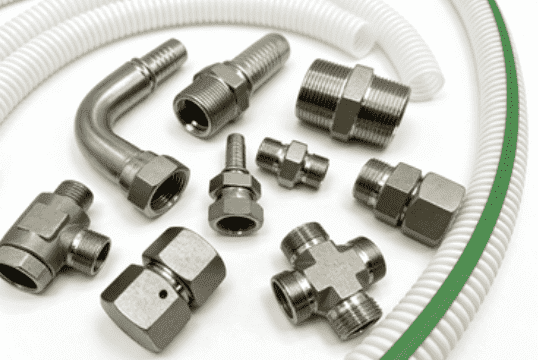
Hydraulic hose fittings types can be categorized by connection method, shape, sealing mechanism, material, and pressure capacity.
Hydraulic Hose Fittings Types by Connection Method
Threaded Fittings
Threaded fittings rely on mechanical threads to create a tight seal. They are widely used in medium-pressure systems (up to 3,500 psi / 24 MPa) and are easy to install.
Applications: General industrial hydraulics, light machinery, and systems with low vibration.
Standards Reference: SAE J514, ISO 8434-1
Crimped Fittings
Crimped fittings are permanently attached using hydraulic crimping machines. They offer the highest reliability under pressure levels up to 6,000 psi (≈41 MPa).
Applications: Construction equipment, mining machinery, heavy-duty industrial systems.
Key Benefit: Leak-resistant, vibration-proof connection.
Reusable Fittings
Reusable fittings allow assembly and disassembly without damaging the hose. They are ideal for field repairs but less suitable for high-vibration or high-pressure systems.
Applications: Temporary installations, field maintenance, emergency repairs.
Hydraulic Hose Fittings Types by Shape Design
Straight Fittings
- Connect hoses in a linear path
- Reduce turbulence and pressure drop in hydraulic lines
- Commonly used in standard industrial systems
Elbow Fittings (45° / 90°)
- Change the direction of hydraulic flow
- Reduce stress on hoses in confined spaces
- Widely used in compact machinery or mobile equipment
Tee and Cross Fittings
- Allow fluid to branch into multiple directions
- Essential for complex hydraulic networks in manufacturing plants
Hydraulic Hose Fittings Types by Sealing Method
O-Ring Seal Fittings
- Use rubber seals to prevent leakage
- Suitable for high-pressure, precision hydraulic systems
- Compatible with standard hydraulic fluids and high-temperature applications
Metal-to-Metal Seal Fittings
- Rely on direct metal contact for sealing
- Offer extreme durability under high pressure and vibration
- Common in heavy-duty applications such as steel mills, presses, and hydraulic presses
Hydraulic Hose Fittings Types by Material
| Material | Advantages | Typical Applications | Pressure Range |
|---|---|---|---|
| Carbon Steel | Durable, cost-effective | Standard industrial machinery | Up to 4,500 psi |
| Stainless Steel | Corrosion-resistant, long lifespan | Marine, chemical plants | Up to 6,000 psi |
| Aluminum | Lightweight, corrosion-resistant | Mobile machinery | Up to 3,000 psi |
| Brass | Excellent corrosion resistance, easy threading | Low-pressure fluid transfer | Up to 1,500 psi |
How to Choose Hydraulic Hose Fittings Types
Pressure Requirement Selection
- High-pressure systems (>4,000 psi) generally require crimped or metal-seal fittings.
- Medium-pressure systems (1,500–3,500 psi) can use threaded or reusable fittings.
- Low-pressure systems (<1,500 psi) may use simple brass or aluminum fittings.
Environmental Considerations
- Temperature extremes: Select materials and seals that maintain performance from -40°C to +150°C.
- Vibration: Crimped and metal-seal fittings reduce fatigue and prevent leaks.
- Chemical exposure: Stainless steel and compatible seals are required for hydraulic fluids containing additives or exposure to corrosive substances.
Compatibility Checks
- Not all hoses match all fittings. Always verify manufacturer specifications.
- Mismatched hoses and fittings can cause leaks, pressure loss, and shortened hose life.
- Cross-reference ISO 12151, SAE J516, and EN 853/854 for standardized compatibility.
Common Mistakes When Selecting Hydraulic Hose Fittings Types
- Ignoring system pressure – Leads to premature failure or hazardous leaks.
- Mixing incompatible standards – Using ISO fittings with SAE threads can cause sealing issues.
- Poor installation practices – Dirt, misalignment, and improper torque reduce reliability.
- Overlooking environmental impact – Temperature, vibration, and chemical exposure affect fitting longevity.
Real-World Case Studies
Case 1: Construction Fleet in Australia
- Problem: Frequent leaks in excavators due to mismatched fittings
- Solution: Replaced old fittings with SAE J516-compliant crimped fittings
- Result: Downtime decreased by 32%, hose replacement costs dropped 18% annually
Case 2: Manufacturing Plant Hydraulic Presses
- Problem: Threaded fittings failing under high vibration
- Solution: Switched to metal-seal crimped fittings per ISO 12151 standards
- Result: Leak incidents eliminated, system efficiency increased by 12%
Case 3: Agricultural Machinery
- Problem: Seasonal field repairs caused frequent downtime
- Solution: Reusable fittings installed for field flexibility
- Result: Reduced repair time and minimized operational disruption
Hydraulic Hose Fittings Types Performance Comparison Table
| Fitting Type | Pressure Level | Reusability | Installation Ease | Best Use |
|---|---|---|---|---|
| Threaded | Medium | Medium | Easy | Standard industrial use |
| Crimped | High | No | Requires machine | Heavy machinery |
| Reusable | Medium | Yes | Manual | Emergency repairs |
| Straight | Medium-High | No | Easy | Linear hydraulic runs |
| Elbow | Medium-High | No | Easy | Tight spaces |
| Tee | Medium | No | Moderate | Branching circuits |
| O-Ring Seal | High | No | Moderate | Precision control |
| Metal Seal | Very High | No | Difficult | Extreme pressure systems |
Emerging Trends in Hydraulic Hose Fittings Types
Smart Hydraulic Systems
- Sensors monitor pressure, detect leaks, and signal maintenance needs in real time.
- Predictive maintenance improves uptime and reduces unexpected failures.
Lightweight Materials
- Aluminum and composite fittings reduce system weight and energy consumption.
Eco-Friendly Hydraulic Designs
- Focus on reduced leakage and energy efficiency for sustainable operations.
Installation and Maintenance Best Practices
- Use calibrated crimping machines to ensure precise pressure.
- Inspect hose ends for contamination before assembly.
- Avoid exceeding bend radius near fittings to prevent reinforcement fatigue.
- Conduct regular inspections based on ISO 12151 and SAE J516 guidelines.
Conclusion
Hydraulic hose fittings types are critical to system reliability, efficiency, and safety. Understanding the differences between threaded, crimped, reusable, straight, elbow, tee, O-ring, and metal-seal fittings allows engineers, buyers, and maintenance personnel to select the most appropriate solutions for their systems.
Following industry standards such as ISO 12151, SAE J516, and EN 853/854, combined with proper installation and maintenance, ensures long-lasting, leak-free performance. Whether in construction, agriculture, or industrial manufacturing, mastering hydraulic hose fittings types is essential for maximizing system uptime and reducing operational costs.
FAQ
What are the most common hydraulic hose fittings types?
Straight, elbow, tee, crimped, threaded, O-ring seal, and metal-to-metal seal fittings are the most widely used types.
How do I choose the right hydraulic hose fittings types for my system?
Consider pressure rating, hose compatibility, operating environment, and intended application.
Are crimped fittings better than reusable fittings?
Crimped fittings provide higher pressure resistance and durability, while reusable fittings allow field flexibility.
What causes hydraulic fitting leakage?
Leakage is typically caused by incorrect installation, incompatible hose/fitting pairings, or exceeding pressure limits.
Can I mix different hydraulic hose fittings types?
Only if standards and thread types are compatible. Mismatched types can lead to system failure.