Key Takeaways
- Misidentifying hydraulic fittings can lead to leakage, system failure, and safety risks
- Understanding thread types, sealing methods, and standards is essential in hydraulic systems
- Key standards include JIC, BSP, DIN, ORFS, and NPT connection types
- Visual inspection alone is not enough—measurement and gauge verification are required
- Material, thread angle, and sealing surface are critical identification factors
- Correct identification reduces downtime and improves hydraulic system reliability
- A structured identification process helps avoid costly procurement and installation errors
Introduction

Hydraulic systems depend on precision-engineered connections to maintain pressure stability and fluid integrity. However, one of the most common issues in hydraulic maintenance and procurement is incorrect fitting identification.
Mistakes in identifying hydraulic fittings can lead to serious consequences such as oil leakage, pressure loss, equipment damage, and even safety hazards. In industrial environments where systems often operate under pressures exceeding 20–40 MPa, even a small mismatch can create system-wide failures.
The process of identifying hydraulic fittings is therefore not just a technical task—it is a critical engineering discipline that ensures system compatibility, operational safety, and long-term cost efficiency.
Table of Contents
Understanding the Basics of Identifying Hydraulic Fittings
What Does Identifying Hydraulic Fittings Mean?
Identifying hydraulic fittings refers to the process of determining the correct type, size, thread standard, and sealing mechanism of a hydraulic connector.
This includes:
- Thread type recognition
- Seal surface identification
- Measurement of diameter and pitch
- Standard classification (ISO, SAE, DIN, BSP, NPT)
Core Concept
Correct identification ensures that hydraulic components can connect securely without leakage or mechanical stress.
Why Misidentification Happens in Industry
Mixed Standards in Global Supply Chains
Different countries use different hydraulic standards, which often leads to confusion in replacement parts.
Visual Similarity Between Fittings
Many hydraulic fittings look identical but differ in thread angle or sealing design.
Lack of Proper Measurement Tools
Field technicians often rely on visual inspection instead of precision tools, increasing error rates.
Key Mistakes in Identifying Hydraulic Fittings
Mistake 1: Assuming All Threads Are the Same
Hydraulic fittings may share similar diameters but differ in thread type and sealing geometry.
Mistake 2: Ignoring Sealing Method Differences
Common sealing types include:
- Metal-to-metal sealing
- O-ring face sealing
- Tapered thread sealing
Each requires a different compatibility match.
Mistake 3: Mixing Metric and Imperial Systems
A major global issue occurs when metric BSP fittings are confused with imperial NPT systems.
Identifying Hydraulic Fittings by Standard Type
Hydraulic Fitting Standards Overview
| Standard | Full Name | Region | Sealing Type | Common Use |
|---|---|---|---|---|
| JIC 37° | Joint Industry Council | North America | Metal flare | High-pressure hydraulics |
| BSP | British Standard Pipe | Europe/Asia | Parallel/tapered | General hydraulics |
| NPT | National Pipe Thread | USA | Tapered thread | Industrial piping |
| DIN | German Industrial Standard | Europe | O-ring sealing | Machinery systems |
| ORFS | O-Ring Face Seal | Global | Flat face O-ring | High vibration systems |
How Standards Affect Compatibility
JIC vs BSP Confusion
Although visually similar, JIC uses a 37° flare while BSP often uses a 60° angle. Mixing them leads to leakage even if threads appear to fit.
NPT Tapered Design
NPT fittings rely on thread deformation for sealing, making them unsuitable for repeated disassembly.
Identifying Hydraulic Fittings by Physical Characteristics
Thread Type Identification
Thread type is the most critical identification factor in hydraulic systems.
Key Concept
Threads may be parallel or tapered, affecting sealing performance and installation torque.
Measuring Thread Size Correctly
Tools Used
- Calipers
- Thread pitch gauges
- Optical comparators (industrial level)
Measurement Concept
Accurate diameter and pitch measurement eliminates guesswork and ensures correct fitting selection.
Seal Surface Inspection
Flat Face Seals
Used in ORFS fittings for leak-free performance.
Cone Seals
Used in JIC fittings for metal-to-metal sealing.
Comparison of Hydraulic Fittings Types
Identifying Hydraulic Fittings by Function
| Type | Pressure Rating | Leak Resistance | Reusability | Installation Difficulty |
|---|---|---|---|---|
| JIC | High | Medium | High | Easy |
| BSP | Medium | Medium | Medium | Easy |
| NPT | Medium | Low-Medium | Low | Moderate |
| ORFS | Very High | Very High | High | Easy |
| DIN | High | High | Medium | Moderate |
Selection Insight
For high-vibration environments, ORFS fittings are preferred due to superior sealing stability. For general industrial use, BSP remains widely adopted due to cost efficiency.
Identifying Hydraulic Fittings in Real Industrial Scenarios

Construction Machinery Systems
Hydraulic excavators and loaders often use a mix of JIC and ORFS fittings due to high vibration and pressure fluctuations.
Oil and Gas Industry
Requires corrosion-resistant DIN or stainless steel fittings for extreme environments.
Manufacturing Automation
Uses standardized BSP or metric fittings for consistent system integration.
Field Identification Techniques for Hydraulic Fittings
Visual Inspection Method
Concept
Technicians first identify external shape and sealing structure.
Limitation
Visual similarity can cause misclassification errors.
Gauge-Based Identification
Concept
Thread gauges provide accurate measurement of pitch and diameter.
Advantage
Reduces error rate significantly compared to visual methods.
Digital Identification Tools
Modern industries use:
- Digital thread scanners
- 3D measurement systems
- AI-assisted identification software
These tools improve accuracy and reduce human error.
Common Problems in Identifying Hydraulic Fittings
Problem 1: Leakage After Installation
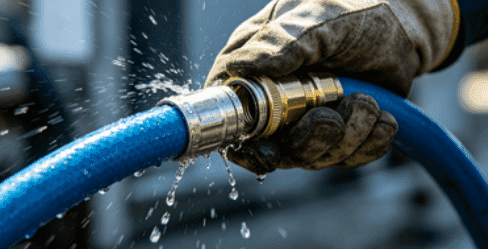
Caused by incorrect thread or sealing mismatch.
Problem 2: Cross-Thread Damage
Occurs when metric and imperial systems are mixed.
Problem 3: Pressure Loss in System
Due to improper sealing surface contact.
Preventing Mistakes in Hydraulic Fitting Identification
Step-by-Step Identification Process
Step 1: Determine Thread Type
Identify whether the fitting is tapered or parallel.
Step 2: Measure Diameter and Pitch
Use proper gauges for accurate measurement.
Step 3: Identify Sealing Method
Check whether sealing is O-ring, metal, or taper-based.
Step 4: Match Standard System
Confirm whether it follows JIC, BSP, DIN, NPT, or ORFS standards.
Industrial Case Study: Hydraulic System Failure Due to Misidentification

Background
A manufacturing plant experienced repeated hydraulic leakage in a production line.
Root Cause
Investigation revealed:
- BSP and NPT fittings were mistakenly interchanged
- Improper sealing caused pressure loss
- Maintenance team relied on visual identification only
Solution
After implementing a standardized identification system:
- Leakage incidents reduced by 85%
- Maintenance downtime decreased significantly
- System reliability improved
Conclusion
Accurate identification of hydraulic fittings is a fundamental requirement in hydraulic system design, maintenance, and procurement. Errors in this process can lead to costly downtime, safety risks, and equipment damage.
By understanding thread standards, sealing mechanisms, measurement techniques, and industrial applications, engineers and technicians can significantly improve system reliability.
A structured approach to identifying hydraulic fittings ensures better compatibility, reduced maintenance costs, and long-term operational safety in industrial hydraulic systems.
FAQ
Why is identifying hydraulic fittings so important?
Incorrect identification can cause leakage, system failure, and safety hazards in high-pressure environments.
What is the most common identification mistake?
Confusing BSP and NPT threads due to similar appearance.
Can I identify hydraulic fittings just by looking at them?
No, accurate identification requires measurement tools and standard verification.
What tools are needed for identification?
Calipers, thread gauges, and sealing profile templates are commonly used.
Which hydraulic fitting standard is most widely used?
JIC and BSP are among the most widely used globally depending on region.